My final words

Hello for the last time! This will be my 10th and final blog post, and I have to admit, it feels good to finish this assignment. As this will be the last post, I want to reflect on the future. And to be more specific, I want to see how virtual reality together with 5G will affect advertising.

According to Business Insiders news article (http://www.businessinsider.com/5g-is-set-to-take-off-in-2023-2017-11), 5G networks (which are 10x faster than 4G) will be subscribed by 1 billion people. This will surely make virtual reality more used in the world. What are the effects of VR in advertising?

Early studies suggest VR ads will increase the same day recall of a brand with 70 %! (According to:
https://www.marketingdive.com/news/study-vr-ads-aid-same-day-recall-for-70-of-users/507755/ ). This is no surprise. Virtual reality is an experience, and as we’ve learned during our course, creating experiences are extremely important, as highlighted by Layne Braunstein:

VR as a technology will fulfil many of the needs we have today: We can get memorable experiences, which are tailored only for us and we get them immediately. This will, in the long run, increase the sales of companies while also being widely known by the broad audience. It’s therefore, in my opinion, very important for companies to start using virtual reality as a part of their content creation. The earlier you start to adapt new technologies, the greater are the chances to reap the profits from it.

Thanks for all my readers! It’s been a fun journey, which now comes to an end. Blomqvist out.
Is the future of advertising audio?

According to Edison Research, the amount of users in both Twitter and Facebook is declining (
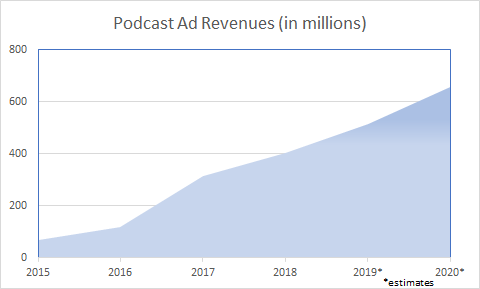
https://www.edisonresearch.com/wp-content/uploads/2019/03/Infinite-Dial-2019-PDF-1.pdf ). This will surely affect advertising, and it seems that podcasting will be the next big trend in advertising, as the graph below highlights:

Data from:
https://musicoomph.com/podcast-statistics/

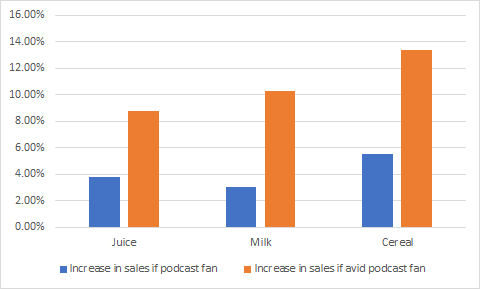
Moreover, Nielsen Company also highlights how much podcasts can affect the sales of common products:

Data from:
https://www.nielsen.com/content/dam/corporate/us/en/reports-downloads/2018-reports/marketeres-guide-to-podcasting-march-2018.pdf .

The stat from Nielsen shows how much podcast ads affect sales, and it’s no wonder when 80 % of consumers (
https://musicoomph.com/podcast-statistics/ ) listen to (almost) the entire episode. This allows companies to place the ads in the middle of the episode, making the consumer listen to the ad. Furthermore, podcasts often have the same ads running for a while (based on my personal experience), which brings the mere exposure effect to consumers. This in turn makes brand recognition and brand recall easier. It’s therefore logical to see why podcasts affect sales figures so mightily.

One additional benefit of audio podcasting is the low costs of making an audio ad. You “only” have to record a few examples, and then choose the best ones to use. This won’t take long, and doesn’t need the same amount of resources than e.g. TV ads. Low costs together with great exposure make audio ads in podcasts attractive, and I personally think audio ads will be a big part of digital advertising in the future, especially when podcasts are becoming even more popular. Do YOU agree with me, are audio ads the next big thing?

What do US podcasting statistics tell us?

I read an EXTREMELY interesting article regarding podcasting statistics in the US. The article can be found here:
https://musicoomph.com/podcast-statistics/. I’ve summarised the most important statistics in the table below for all the lazy ones:

Business is the 2nd most popular genre
25-44 y.o. are the most active listeners
80 % listen to the entire episode/most of the episode
Listeners are more active on social media
69 % agreed that podcast ads made them more aware of new products
45 % of listeners are more likely to have $250,000+ annual income!

These statistics show, that adults with a high purchasing power are the most avid listeners of podcasts. This is something that companies producing e.g. luxury products should utilise. They could create podcasts about the history of the brand, new trends in the industry and more detailed stories about the company. In this way, companies would increase awareness, loyalty and buzz around the brand. And as I said in my blog post last week, meaningful content is one of the most important things in social media marketing, and podcasts are definitely one platform that could help create relevant content.

With 80 % of the population listening to almost the entire episode, podcasts seem to be the ultimate platform to provide meaningful content to customers. Those who listen to the podcasts seem to be interested in the topic and will surely listen to the most of it, thus providing an important platform for creating meaningful relationships with customers. This might be the most important thing with podcasts: they have become building blocks in building valuable, long term relationships with customers, as those who take the time to listen to podcasts will surely listen to and reflect on the information provided.

What do you think, what else can we conclude from the statistics in the article?

How B2B companies can utilise social media

When you think about SMM, which companies come to mind? For me, most of the companies that come to mind are B2C companies. You see influencers promoting clothes, foods etc., but rarely anything B2B related. And to be honest, you rarely see or feel the presences of B2B companies on social media. This should not be the case, as there are plenty of advantages with SMM (
https://www.forbes.com/sites/jaysondemers/2014/08/11/the-top-10-benefits-of-social-media-marketing/#1eff6d471f80 )

This raises a question: How should B2B companies use social media? In my opinion, the main thing is to create meaningful content (surprise!). In order to make meaningful content, a target audience should be chosen. This helps social media marketers to create meaningful content. For example, Airbus uses social media to showcase themselves (
https://shortyawards.com/6th/flying-high-with-airbus ). This article tells, that Airbus has made Vines so that their customers can see how their new planes work, and they’ve had live videos on Youtube and Facebook from test-flights (Shorty Awards 2019). This shows that Airbus has targeted their audience, and in that way created meaningful content through social media for their customers. No wonder they were nominated as one of the best B2B companies on social media (Shorty Awards 2019).

Another important aspect that B2B companies should use in their SMM is a personality (
https://sproutsocial.com/insights/b2b-social-media-strategy/ ). This includes using humour, responding to posts on social media and being more informal (per Dominique Jackson from the aforementioned article). It’s easy to see why this is a good strategy. You build a more personalised and unique look about your company, thus differentiating yourselves from competitors. Even though B2B companies don’t directly interact individual customers, they still interact with human beings in other organisations, therefore highlighting the importance of the human aspect on social media accounts.

Which other social media strategies are important for B2B companies in your opinion?


Data-driven marketing: The devil?

Hey, it’s me again. This week’s post will be about data-driven marketing.

This video by the economist, even if it’s 4 years old, is still explaining thoroughly data in marketing. Make sure to check it out!

I personally dislike and avoid giving up data, as it feels like my every move is being followed. It often scares me when I get an ad about a topic I talked about over coffee with my friends. It feels like this crosses my personal boundaries, and that’s why the European Union’s data regulation is a good thing in my opinion.

Even though you can make personalised ads, which is the greatest advantage of data in marketing, they don’t always make sense if there isn’t enough data. I have an example of the negative effects from my own life. In Europe, there’s a big online clothing retail company, called Zalando. I once bought boxers through them, and after that, I received weekly email letters of clothes that suit me the best. Every time, the email consisted of almost entirely boxers. Thus, I haven’t used Zalando as much anymore. This is a perfect example on how algorithmic marketing can affect a company negatively, and annoy its customers. I’m sure you’ve also had a similar experience with e.g. ticket prices for different flights.

What do you, my dear readers, think about this? Does the good in data-driven marketing outweigh the bad things?

An ode to word-of-mouth

Think about the 1950s. UNIVAC 1, the first commercialized computer in the U.S. (https://en.wikipedia.org/wiki/UNIVAC_I), was introduced. The Mickey Mouse House Club TV show started to air (https://en.wikipedia.org/wiki/The_Mickey_Mouse_Club). Even though you watched TV, life was mostly analogue back then. If you wanted to try a new restaurant, you might’ve read reviews from the paper, but mostly your knowledge of a restaurant consisted of word-of-mouth.

Today, life is easier. You can go to TripAdvisor to see which restaurants are the best. You can also see tons of reviews of hotels online. Word-of-mouth still lives on, but in a different form. Instead of telling your neighbours face-to-face about the restaurant, your opinion can be found online, where a Jere from Finland can make his decision based on your review. In today’s world, news and information spread like wildfire. Even if you have the perfect strategy, it might not be enough if you receive tons of bad reviews online. You can argue, that these reviews are the most important moments of truths along companies touch points. This means, that companies products and services need to be in shape. If they aren’t, you’re in the risk of having a social media slandering, which will affect your whole business!

What’s even better nowadays (for us consumers), word-of-mouth consists of a larger sample size. Thus, you can make your decision based on thousands of reviews, not only on your friends or neighbour’s opinion. Even though technology has made wonderful strides, it has allowed the most basic marketing strategy to blossom. Your product and company have to have a good reputation these days.

Until next week, friends!

Problems with SMM for the NBA & in general

This week I’ll dive into the problems of social media marketing. A big problem around social media is the well-known issue of mental health
https://www.independent.co.uk/life-style/health-and-families/social-media-mental-health-negative-effects-depression-anxiety-addiction-memory-a8307196.html. Heavy use of social media has in many cases led to anxiety and depression, and that has also started to affect the NBA and its players. Many well written articles
https://bleacherreport.com/articles/2824656-dirk-nowitzki-social-media-changing-how-modern-nba-players-view-winning or
https://bleacherreport.com/articles/2798257-is-social-media-addiction-in-the-nba-out-of-control have reported that players are negatively affected by the constant pressure of social media. Anyone can go out on Twitter and criticise you anonymously, which for products like sports can have negative effects.

Even though more traditional products don’t have the same issues as the NBA, all companies should discuss the use of social media from an ethical point of view. How much should you promote your product on Instagram? Should you promote your product through a popular game application or a social influencer, even though you are aware that people feel anxiety when using social media? As lately as this week, a social influencer was caught eating fish
https://www.news.com.au/lifestyle/health/diet/vegan-blogger-slammed-for-admitting-shes-started-eating-fish-and-eggs/news-story/78c411ad728c86c5064502b36849c84f, even though she’s been promoting veganism for the past few years, causing a major ethical dispute for herself and the companies sponsoring her. This, together with the NBAs example shows, that there’s a fine line with social media marketing.

I’m still undecided on next week’s topic. I’m thinking about technology, or a regression analysis on the determinants of social media following for sports teams. If you want, you can comment and tell me which one you want. Until next time!

NBAs use of social media

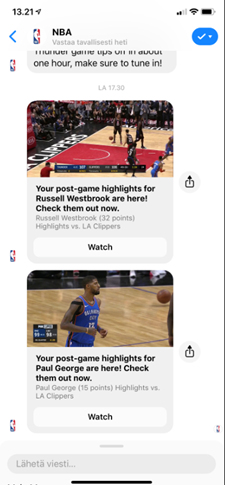
Hi again friends! This week I’ll continue showing why NBA is the king of social media in sports. I will start with showing you how interactive NBA is with the use of social media. Below you can see a screenshot from my iPhone:

The screenshot is taken from Facebook. You can see how the NBA through social media keeps me engaged with their product (i.e. the games). By opening the NBA on Facebook messenger, I can choose to be reminded when my favourite teams game starts. I can also receive highlights for my favourite players a few minutes after the game has ended. In this way, the NBA uses social media to both attract and retain customers, which can be seen as two key aspects of brand management. Moreover, as consumers expect to be able to interact with businesses through multiple online channels (https://www2.deloitte.com/us/en/pages/technology-media-and-telecommunications/articles/connected-small-businesses.html), NBA fulfils the needs of modern customers.

Facebook isn’t the only online platform for NBA to attract and retain customers. My last posting showed you how the league uses Twitter, but NBA is also very active on YouTube. The official channel provides highlights from games and other actions around the league.

In the video above, you can see highlights of NBA games on March 9th. If you look at the 0.42 mark of the video, you can see how Red Bull and its logo is showed to the viewer. NBAs use of social media concentrates also on exposure for sponsors. By providing exposure on multiple platforms, the NBA makes sure that sponsors will be shown and associated with the NBA.

Next week I’ll focus on some problems with NBA & social media. See you!

Why NBA rules sports social media

Welcome to my second posting. Now I’ll explain what makes the NBAs social media great compared to NFL and MLB.

I will start with an article written by Seerat Sohi (https://www.sbnation.com/2018/10/10/17950062/nba-tv-ratings-twitter-social-media-rise). This article explains beautifully how social media has turned the TV ratings of NBA upwards.

In the article, Sohi writes that the NFL banned its teams from using videos and GIFs on social media in 2016, while the NBA embraced the use of social media. Players in the NBA regularly engage with fans on social media. For example, superstar Kevin Durant responds to fans on Twitter on a regular basis (https://fadeawayworld.net/2018/07/26/kevin-durant-caught-arguing-with-fan-on-twitter-deletes-tweets-afterwards/). This engages the fans to talk more about the NBA (maybe in hopes of an answer by their favourite player) on social media, which in turn increases the exposure of NBA. This smart (and free!) makes sure that the NBA will be discussed no matter what, which in turn will make people more interested in the sport.

NBA is also known for its “twitter drama”. Everything that happens around the league is heavily discussed on Twitter, therefore creating even more interest around the sport. It’s not unusual that the players themselves participate in the discussions. For example, when Mario Hezonja from the New York Knicks blocked Lebron James’s last second shot, Enes Kanter (player for Portland Trail Blazers) mocked Lebron with Lebron’s own signature hashtag.

#StriveForGreatness 😂🗽— Enes Kanter (@Enes_Kanter) 17 March 2019

Another example on players using social media is Joel Embiid “trolling” his opponent, Andre Drummond:

I own a lot of real estate in @andredrummondd head and I’m on my way to build more 🏘🏘🏘 #Bum #TheProcess pic.twitter.com/Mrf2NcNL4r— Joel Embiid (@JoelEmbiid) 3 November 2018

With the use of social media, the NBA and the players have created a new kind of stimuli to raise awareness and attention to its product, especially for generation Y. However, the drama and player engagement isn’t the only thing that has made NBAs use of social media so great. More on this topic next week. See you!

The journey begins

Hi there! I’m Jere and this is going to be my first blog post. This blog will focus on two things that interest me the most; sports and technology (mainly AI and other data driven applications). Thus, I will post digital marketing subjects regarding these two topics.

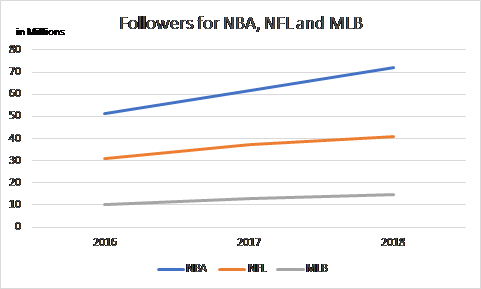
My first deep dive is on how social media marketing differs between the NBA and the two other popular sports leagues in the US (NFL and MLB). In this case, I will mainly focus on OSNs (Online Social Networks). According to data from Social Blade (https://socialblade.com/), NBA has a major advantage in followers across Twitter, Instagram and Youtube (Facebook isn’t included due to lack of data). This can be seen from the graph I made below:

Data from: https://socialblade.com/

The graph above shows the total amount of followers in the aforementioned social media platforms. As the graph shows, NBAs total amount of followers exceeds both NFLs and MLBs number of followers – even if you combined the number of followers for those two leagues!

You might wonder if the number of followers actually make a difference, but according to Nielsen Sports (https://nielsensports.com/nba-teams-score-slam-dunk-social-media/), the value of NBAs social media activity for sponsor exceeds 490 million US dollars! Because the NBA is thoroughly followed on social media, sponsors and their brands are constantly viewed by fans of the NBA, thus displaying the brand and its products to potential customers.

Next week I will show you why NBA dominates the social media scene. See you!